Custom-designed specialty lenses that vault the cornea to restore crisp 20/20 vision in eyes that glasses, soft lenses or even surgery can no longer correct. The non-surgical breakthrough for keratoconus, post-LASIK ectasia, corneal scarring and other irregular cornea conditions.
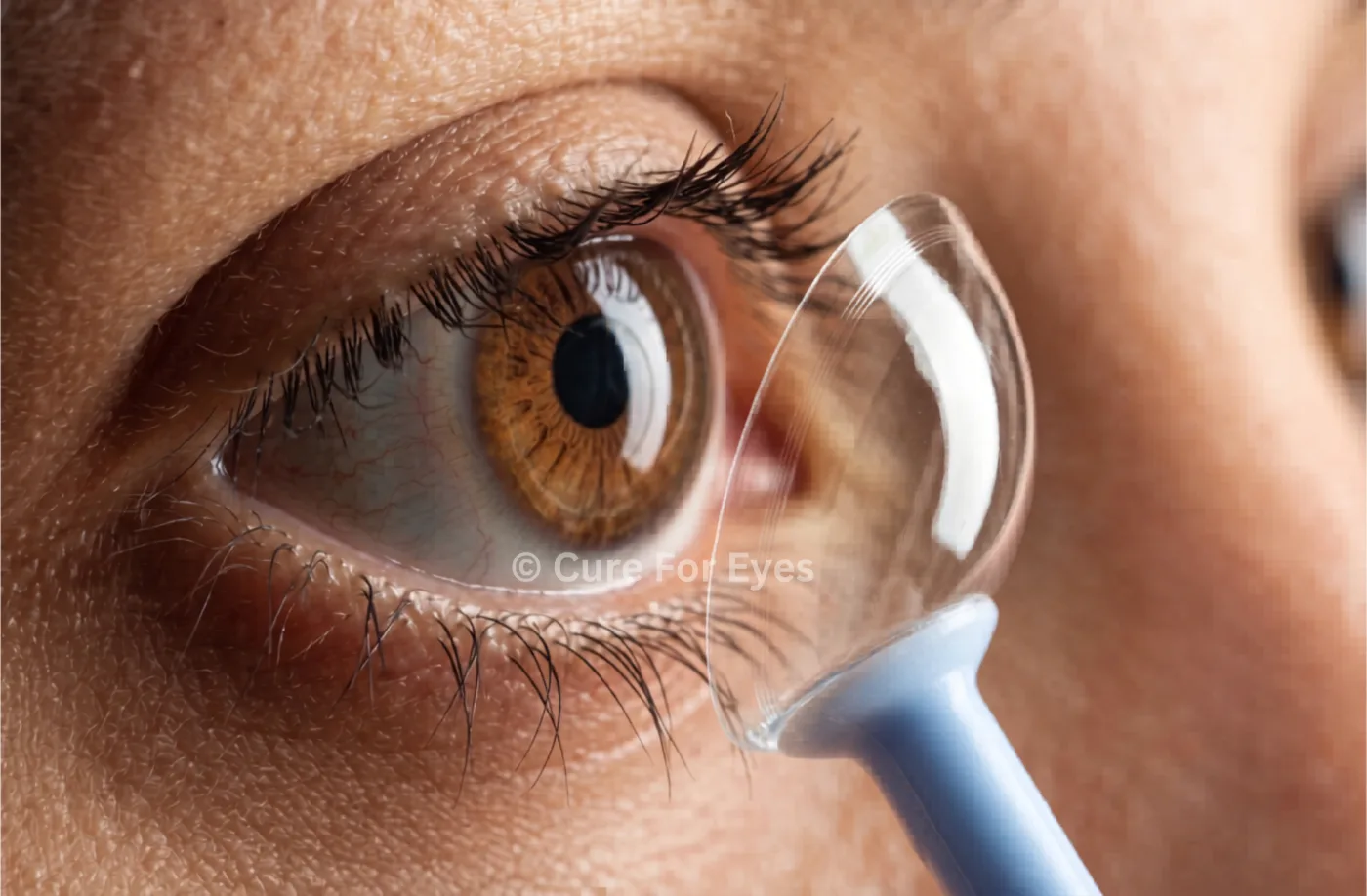
For eyes with an uneven, scarred or thinning cornea, light scatters before it can focus. Scleral and RGP lenses replace that irregular optical surface with a perfect tear-filled dome, instantly turning blurred, ghosted vision back into something sharp and clear vision.
Progressive corneal thinning causing a cone-shaped bulge, distorted vision and frequent prescription changes. Scleral lenses are the gold-standard non-surgical option.
Learn more →A rarer cousin of keratoconus where the inferior cornea thins. Often misdiagnosed; responds extremely well to large-diameter scleral fittings.
Learn more →Progressive bulging after refractive surgery. Specialty lenses safely restore vision when laser enhancement is no longer an option.
Learn more →Scars from infection, injury, chemical burns or surgery create irregular astigmatism. Sclerals vault over the scar and deliver a fresh optical surface.
Learn more →After a transplant, suture-induced astigmatism is common. Custom RGPs and sclerals deliver functional vision while protecting the graft.
Learn more →The fluid reservoir behind a scleral lens continually bathes the cornea - transformative for Sjögren's, post-radiation, GVHD and chronic dry eye.
Learn more →When astigmatism exceeds what toric soft lenses can manage, custom RGPs deliver sharper, more stable optics with no rotation issues.
Learn more →Very high myopia, hyperopia or post-cataract aphakia where glasses are unmanageably thick - specialty lenses give comfortable, lightweight clarity.
Learn more →Book a corneal topography consult. We map your cornea in 4 minutes and tell you exactly what's going on and whether specialty lenses are the right answer.
Book free consult →Soft and standard lenses sit on the cornea and conform to its shape. If the cornea is irregular, vision stays irregular. Scleral lenses are different: they're larger in diameter, rest entirely on the white of the eye, and arch over the cornea with a thin tear-filled chamber underneath. Light enters through a smooth dome and dryness has nowhere to start.
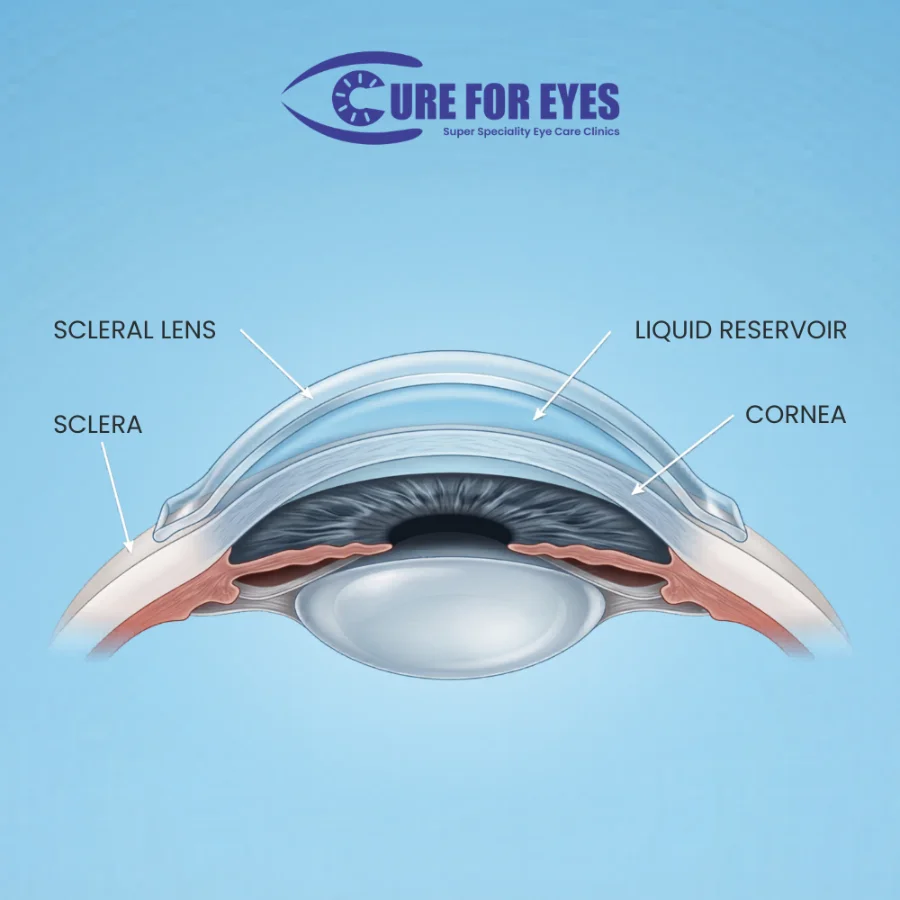
The lens diameter (15–22 mm) lets it rest entirely on the white of the eye - one of the least sensitive tissues in the body.
A custom-shaped dome arches above even the steepest cone or scar. The cornea is no longer touched, irritated or distorted by lens contact.
The space between the lens and cornea fills with fresh saline. Light now travels through a perfectly smooth liquid surface - not the irregular cornea underneath.
Because the lens doesn't move with blinks the way RGPs do, vision is rock-stable. Most patients wear sclerals 12–16 hours a day with zero discomfort.
After a full corneal map your optometrist will recommend the family that best balances comfort, optics and your daily routine. Many patients use both - sclerals at work, RGPs for sport.
Large-diameter rigid lenses that vault completely over the cornea and rest on the sclera. The gold standard for moderate-to-severe keratoconus, post-graft eyes, and chronic dry-eye sufferers.
Smaller, traditional rigid gas-permeable lenses that sit on the cornea itself. Lower cost, easier handling, and often the right answer for mild keratoconus or high astigmatism.
Specialty lenses are precision medical devices. We invest in getting your fit right the first time, with high-resolution imaging and as many trial lenses as needed at no extra cost.
Full slit-lamp exam, history & visual goals discussion. Understand whether specialty lenses are right for you.
Pentacam/Sirius scans build a micron-accurate 3D map of your cornea, sclera and tear film.
Diagnostic lenses placed live in clinic. We assess vault, edge alignment and instant visual acuity.
Your custom lens is designed and lathed to your eye's exact parameters by global specialty labs.
Insertion, removal & hygiene training. 1-week and 1-month follow-ups included in every fitting.
More than 90% of patients we evaluate for keratoconus and irregular cornea conditions are good candidates. Here's the broad picture - only a corneal exam can give you a definitive answer.
| For an irregular cornea | Glasses | Soft / Toric Lenses | Scleral / RGP | Corneal Surgery |
|---|---|---|---|---|
| Restores 20/20 vision | Rarely | Sometimes | Yes - in most cases | Usually |
| Non-surgical & reversible | Yes | Yes | Yes | No |
| Halts cornea distortion | No | No | Optically masks it | Often |
| Comfortable in dry eyes | Yes | No | Excellent | Variable |
| Suitable for advanced keratoconus | No | No | Yes | Yes |
| Recovery time | None | None | 1–2 weeks adapt | 3–12 months |
| Typical cost (₹) | Low | Low | Moderate | High |
"Main toh corneal transplant ke liye prepare kar raha tha. Sclerals ne mujhe pehle hi din 6/9 vision de di."
Mera keratoconus itna zyada badh gaya tha ki glasses bilkul useless the, aur hard lenses toh main bardaasht hi nahi kar paata tha. Team ne meri eyes map kari aur usi week mujhe scleral lens fit kar diya. Jab main clinic se bahar nikla, toh mujhe itna clear dikh raha tha jitna pichle 5 saalo mein kabhi nahi dikha.
"Post-LASIK ectasia sach mein ek nightmare tha. Sclerals ne toh mera graphic designer ka career hi bacha liya."
LASIK ke do saal baad hi mujhe cheezein wapas blurry dikhne lag gayi thi. Mere surgeon ne saaf bol diya tha ki ab enhancement safe nahi hai. Phir CFE ne mere liye ek custom scleral design kiya, aur ab meri vision screen par wapas 6/6 hai !
"Meri beti ko Sjögren's hai. Pichle 10 saalo mein scleral lenses hi aisi pehli cheez hai jisne uske dry eyes mein sach mein aaraam diya hai."
Pehle use har 20 minute mein drops daalne padte the. Par ab sclerals ki wajah se uski aankhein poora din saline mein rehti hain. Uske teachers bhi batate hain ki ab uska concentration ekdum improve ho gaya hai. Hum log sach mein bahut grateful hain ki humein finally yeh option mil gaya.
"I'd been told nothing else could help my post-graft astigmatism. The CFE fitting changed that."
After a corneal graft I had 8 dioptres of astigmatism - not available in any soft lens. The custom RGP they designed dropped my Rx to plano and finally let me read price tags in the supermarket.
"My 14-year-old is finally back to cricket without thick glasses sliding off his face."
Pellucid marginal degeneration was diagnosed late and his prescription kept changing. With his scleral lenses he wears them to school, sport and everything in between. He picks them up himself now.
"I waited 15 years to find someone who could fit my eye correctly. So worth it."
I'd been to three other clinics across Delhi-NCR. CFE was the first to provide real advice and not moneymaking like others. The fit was perfect from week one. I should have come here a decade ago.
No. This surprises most patients. Because the lens rests on the sclera (the white of the eye) and never touches the sensitive cornea, scleral lenses are typically more comfortable than even soft lenses. Most people forget they're wearing them within a few hours. A short 1–2 week adaptation period is normal.
Scleral lenses do not change the structural progression of keratoconus - for that, corneal cross-linking (C3R) is the recommended treatment, and we co-manage that with corneal specialists when needed. However, scleral lenses dramatically restore the vision that keratoconus has taken away, often delaying or removing the need for a corneal transplant.
With proper care, scleral lenses typically last 1.5–2 years before needing replacement. Corneal RGPs last 1–2 years. The exact lifespan depends on protein deposits, your cleaning routine and any changes in your corneal shape. We review fit at every 6-month check-up.
Many Indian insurance providers reimburse medically-necessary specialty contact lenses for keratoconus, post-graft and post-trauma eyes - especially when a corneal specialist has documented the irregularity. We provide all the diagnostic reports and prescriptions needed to support a claim, and our team can guide you through it.
Pricing depends on complexity (one eye or two), the lens design selected and the brand of material. The fitting package covers your diagnostic imaging, all trial lenses, the final lens manufacture and three months of follow-up. EMI options are available. Please contact our clinic for a personalised quote - we never quote blind.
You should remove specialty lenses before sleeping - they are daily-wear devices. Avoid swimming or hot tubs while wearing them due to infection risk. Most sports are perfectly fine, especially with goggles; sclerals are particularly stable for high-motion activities because they don't shift on the eye the way smaller RGPs can.
This is one of the most common reasons patients come to us. A poor RGP fit is uncomfortable; the right specialty lens shouldn't be. We almost always succeed where smaller RGPs failed, either by refining the corneal RGP design or by transitioning you to a scleral lens. Bring your old lenses to the consultation - they help us understand what didn't work.
Book a no-obligation specialty-lens assessment at our Gurugram clinic. We'll map your cornea, walk you through your options, and tell you honestly whether scleral or RGP lenses are right for you.
